
Research / 25 October 2026
The second failure:
What happens after a connected pre-pack sale?
An analysis of 1,738 administrations from 2019, following pre-pack buyers through to 2026 to explore connected-party sales, subsequent buyer insolvency and returns to unsecured creditors.
When a company enters administration, a pre-pack sale can move quickly. The business or its assets are sold, sometimes to people already connected to the company, and a new business carries on.
At that point, much of the attention is understandably on the company that failed, including what creditors will recover, what happens to employees, and if value has been preserved.
But what happens to the buyer?
Turnstone Intelligence analysed 1,738 companies entering administration in England and Wales in 2019, covering substantially the year’s administrations. We identified 544 pre-pack sales and followed the businesses that bought them through to July 2026.
That gave us almost seven years of subsequent company history to examine.
We wanted to understand whether connected-party buyers followed the same path as unconnected buyers. We also looked at the structure of those transactions, including where consideration was deferred, and what the available records could tell us about returns to unsecured creditors.
One result stood out. Connected pre-pack buyers subsequently entered insolvency at around 1.7 times the rate of unconnected buyers: 44% compared with 26%.
The findings raise key points about what happens after a pre-pack sale, the information available when assessing connected businesses, and how much company history and relationships can tell us about risk.
You can find the full report below.
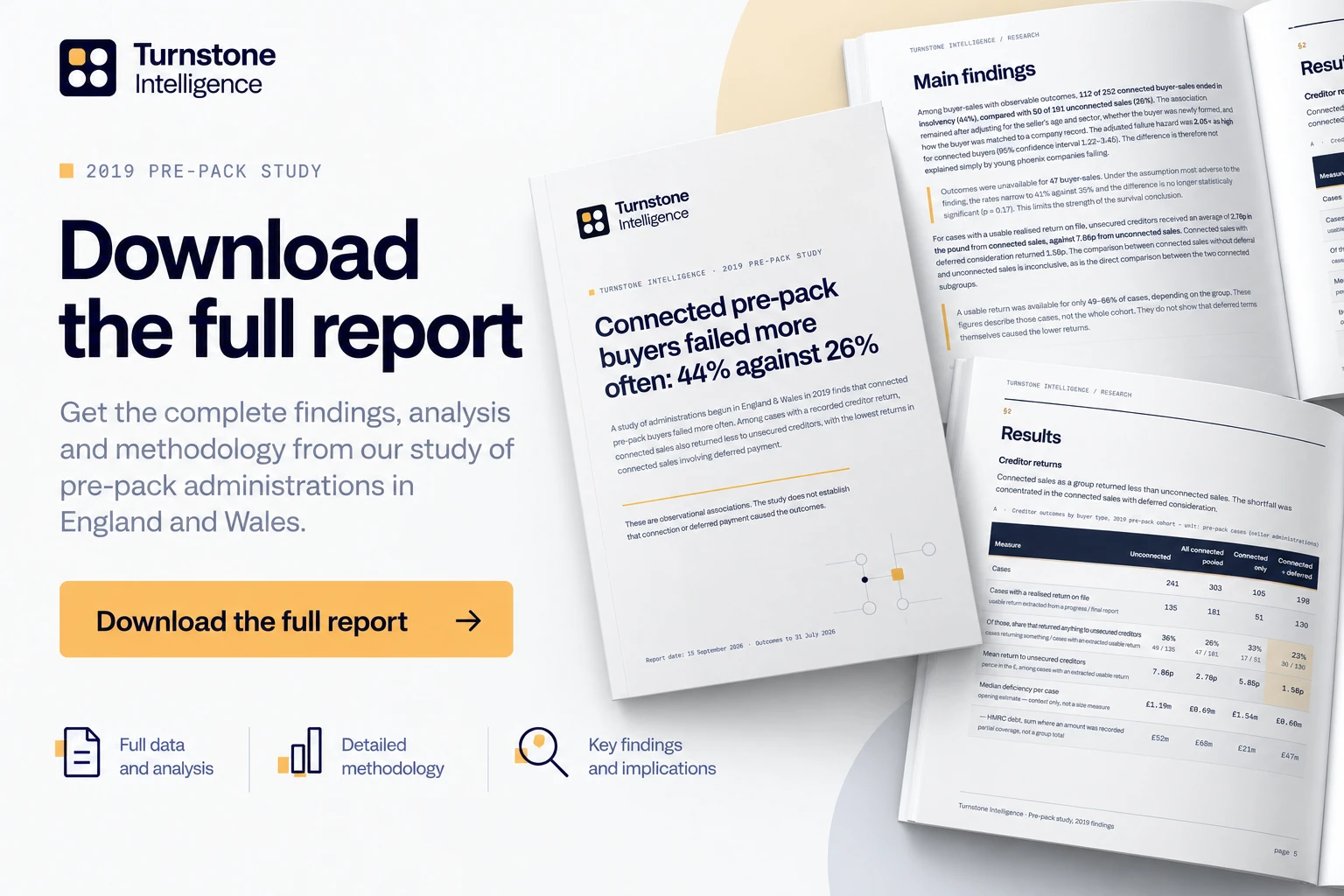
Curious to learn more about the findings and our perspective? You’ll just have to keep reading ⬇️
Key takeaways
- Connected buyers failed at around 1.7 times the rate: 44% of connected pre-pack buyers subsequently entered insolvency, compared with 26% of unconnected buyers.
- The difference remained after adjustment: After controlling for seller age, sector, if the buyer was newly formed, and buyer-match route, connected buyers still had about twice the failure hazard of unconnected buyers (2.05×).
- Connected + deferred sales had the lowest observed creditor returns: Among cases with a realised return report, unsecured creditors received an average of 1.6p in the pound, compared with 7.9p for unconnected sales.
- The research shows association, rather than causation: In particular, the findings do not establish that deferred consideration itself caused poorer creditor outcomes.
- 2019 gives us a pre-reform benchmark: Following buyers through to July 2026 provides almost seven years of history and creates a baseline for future research into whether outcomes have changed since the 2021 connected-party reforms.
We followed almost an entire year of administrations
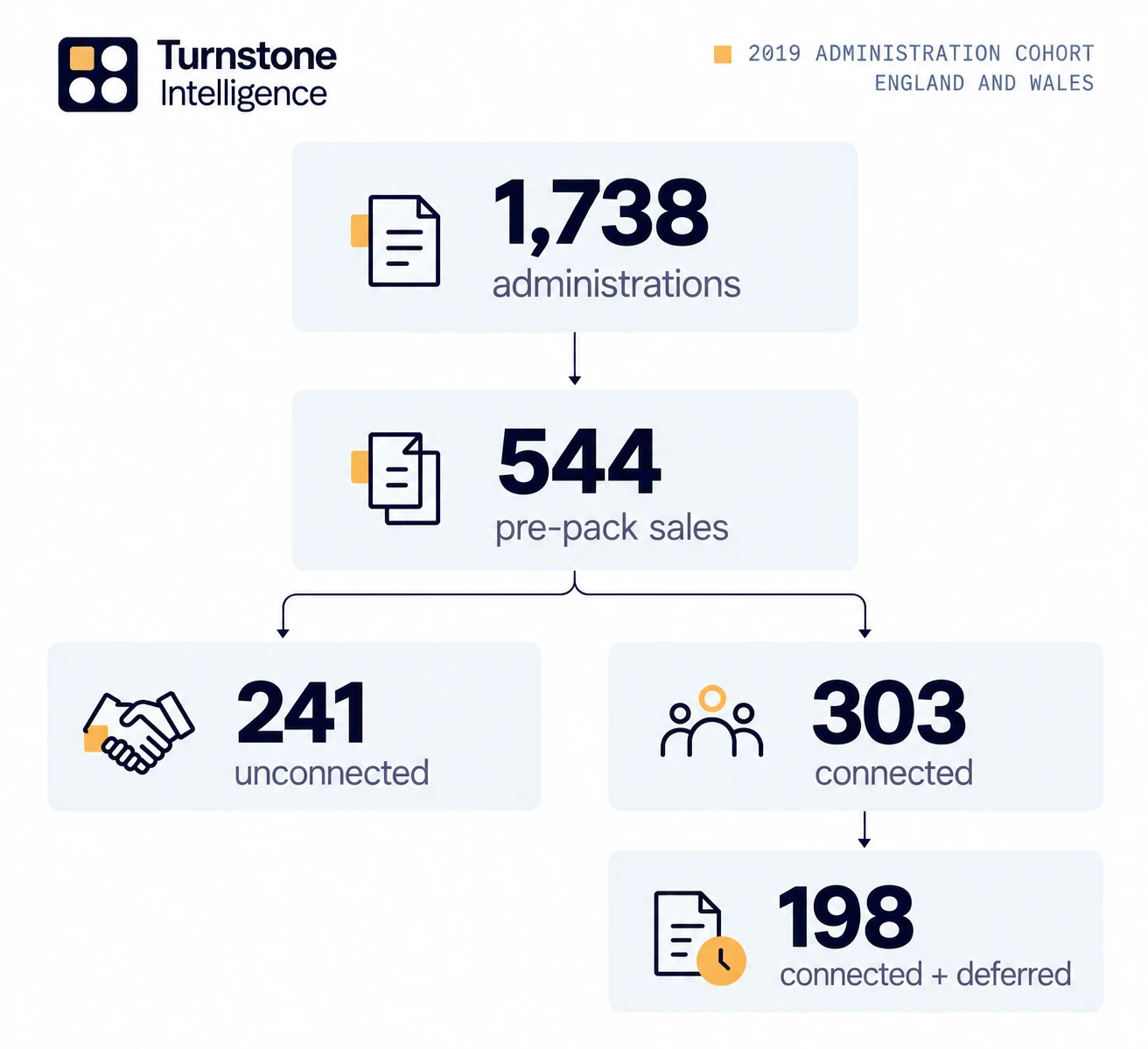
To find out what happened after the sale, we needed to look beyond individual cases. Turnstone Intelligence identified 1,738 companies that entered administration in England and Wales during 2019, covering substantially the appointment-year population.
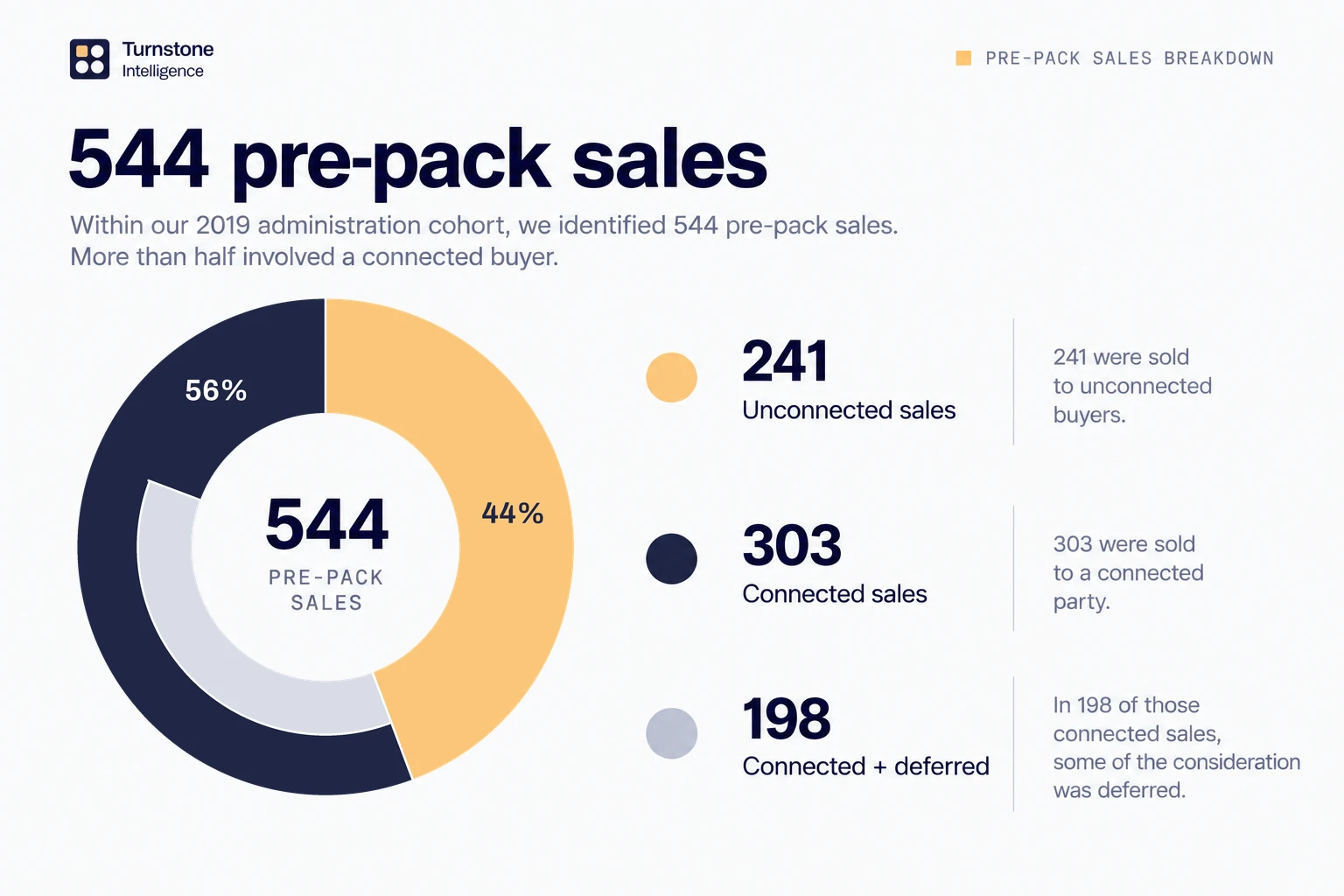
Within that group, we identified 544 pre-pack sales.
More than half involved a connected buyer.
- 241 were sold to unconnected buyers.
- 303 were sold to a connected party.
- And in 198 of those connected sales, some of the consideration was deferred.
That gave us a substantial group of businesses whose buyers could be followed over time, allowing us to see what happened in the years after the original company entered administration.
Why 2019? It gives us something relatively unusual in company research: time.
By following buyers through to 31 July 2026, we could observe almost seven years of subsequent company history. The cohort also predates the connected-party reforms introduced in 2021, giving us a useful baseline for understanding what was happening before the rules changed.
And when we followed those buyers forward, a clear difference emerged.
What happened to the buyers?
We followed the buyers to see how many subsequently entered an insolvent procedure, and the difference was substantial.
Among unconnected buyers, 26% later entered insolvency (50 of 191).
For connected buyers, that figure rose to 44% (112 of 252).
And where the connected sale also involved deferred consideration, the rate was 44% (74 of 169).
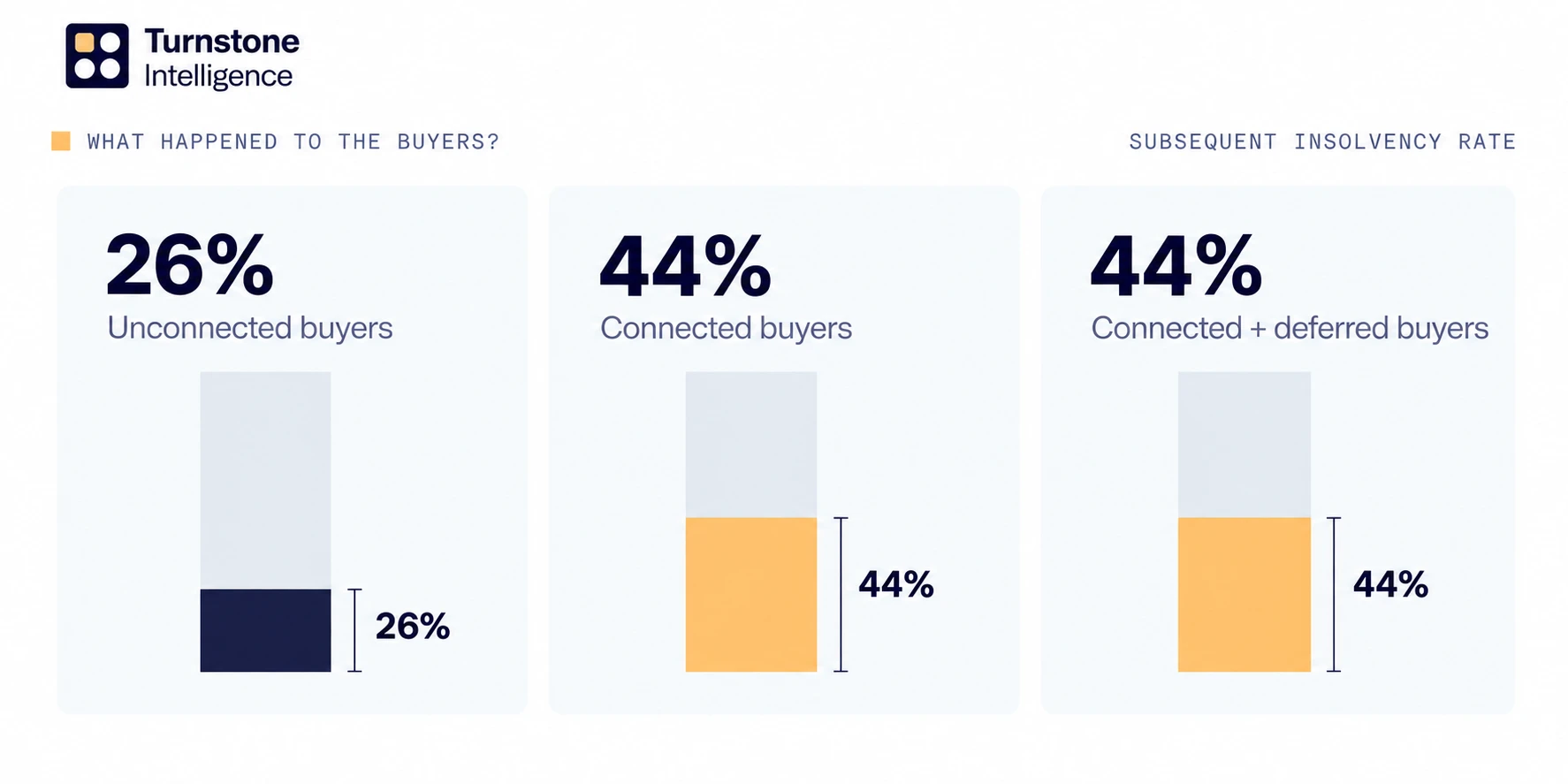
So, across both connected groups, buyers subsequently failed at around 1.7 times the rate seen among unconnected buyers. Even under the assumption most adverse to this finding (every unmatched unconnected buyer failing, every unmatched connected buyer surviving), connected buyers still failed more often, though the difference was then no longer statistically clear. That is why we present it as a strong association rather than a settled conclusion.
The insolvency rates immediately raised another question.
Could something else explain the difference?
Connected-party sales can look different from unconnected transactions in several ways. The companies involved may be younger, operate in different sectors, or use newly formed businesses as buyers.
So we tested whether those differences could account for what we were seeing.
The analysis controlled for seller age, sector, if the buyer was newly formed, and the route used to match the buyer.
Yet the gap remained.
After adjustment, connected buyers had about twice the failure hazard of unconnected buyers (2.05×). The estimate was around 2.2 times as high for connected-only buyers, and 1.96 times for connected buyers where consideration was also deferred.
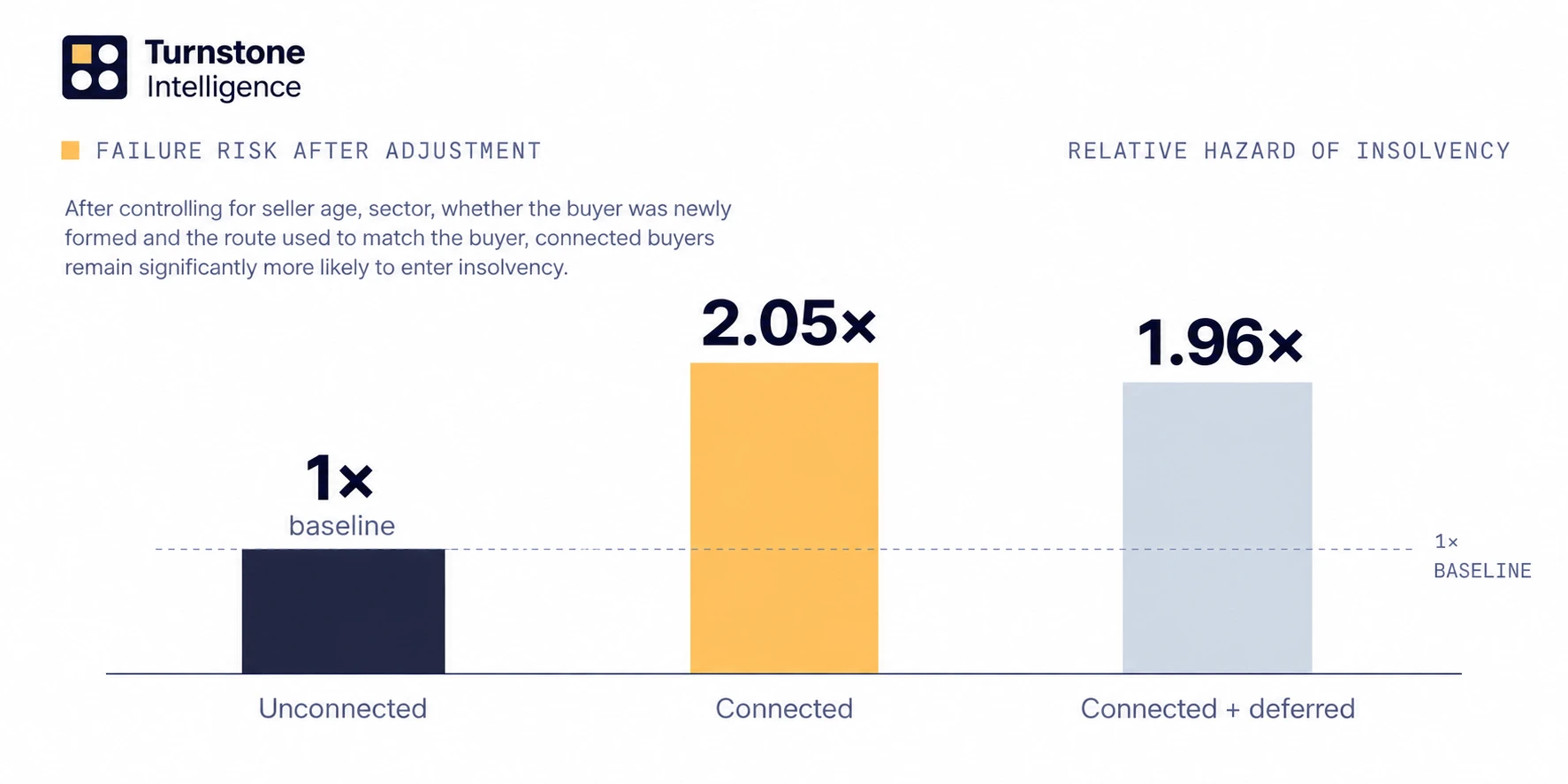
The data therefore points to a persistent association between a connected-party purchase and the buyer’s subsequent risk of insolvency, even after accounting for those observable differences.
It also gave us a reason to look beyond what happened to the survivor.
And what happened to the creditors?
Buyer survival tells us what happened after the sale. We also wanted to understand the outcome of the original administration. Where a realised return report was available, there was again a marked difference.
Unsecured creditors in unconnected pre-packs received an average of 7.9p in the pound.
For connected sales, the average was 2.8p.
Where the buyer was connected and the sale included deferred consideration, the average fell to 1.6p in the pound.
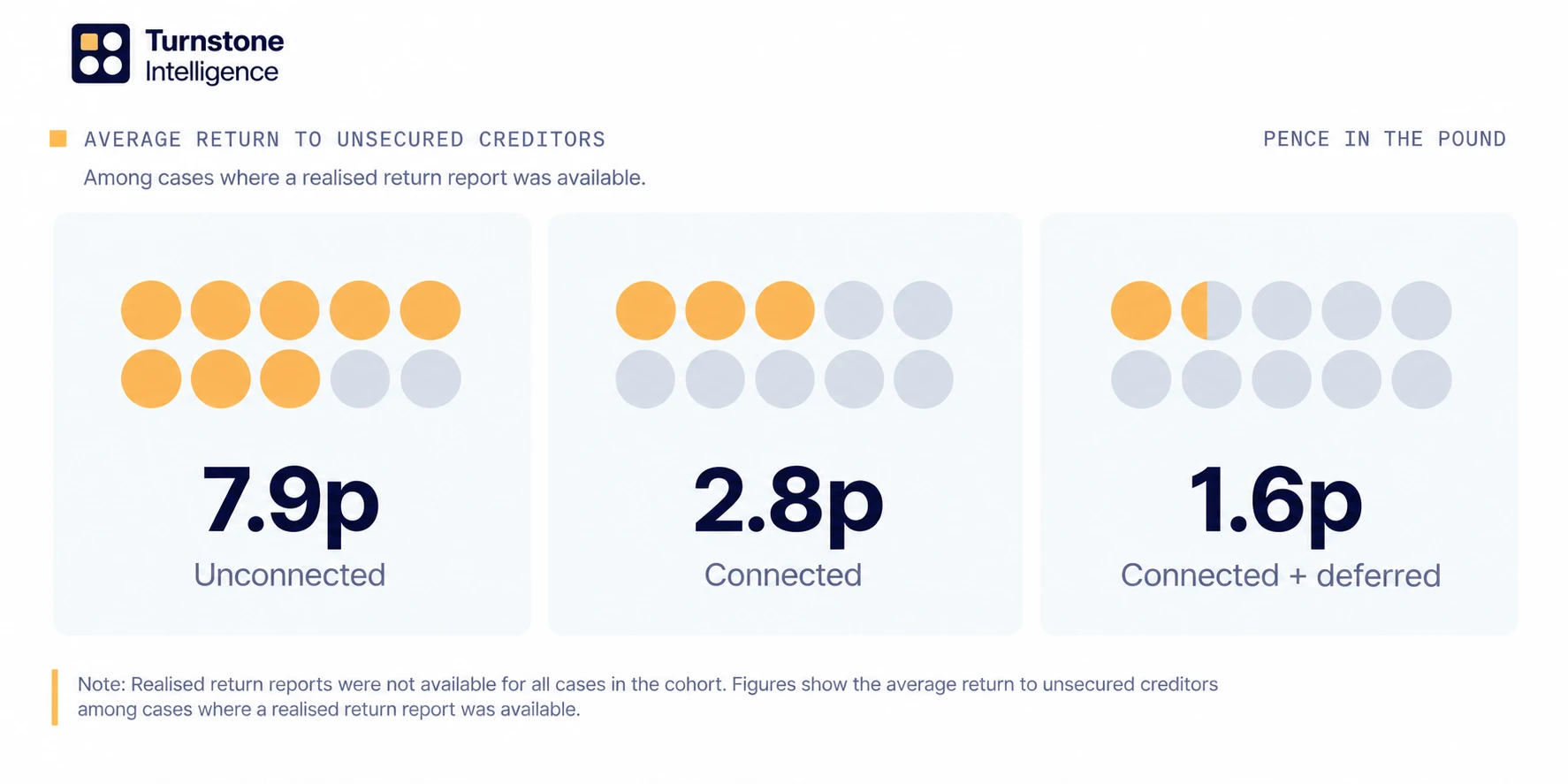
We saw a similar pattern in the proportion of unsecured creditors receiving a return.
36% of unconnected cases with a realised return report recorded some return to unsecured creditors, compared with 33% of connected-only cases and 23% of connected + deferred cases.
The 1.6p finding deserves a closer look
The difference between unconnected and connected + deferred sales is substantial. In the available data, this was also statistically significant.
But there is an important limit to what we can conclude from it.
The research shows an association between connected + deferred sales and lower realised returns. It does not establish that deferred consideration itself caused those poorer outcomes. When the two connected groups were compared directly, the difference was not statistically robust.
There is another limitation worth keeping in view. Realised return reports were available for only around half to two-thirds of cases, depending on the group. These figures therefore describe the cases where a realised return could be observed, rather than every pre-pack in the study.
Even with those caveats, the findings add further context: the group associated with a high rate of subsequent buyer insolvency also contained the lowest observed creditor returns.
And behind every one of these numbers is a real chain of companies, people, and decisions. One case shows how that chain can unfold.
What does a second failure look like?
The percentages show how often unsecured creditors received anything back. Looking at one case gives us more detail.
DRB Power Transmission Ltd entered administration in July 2019. Its business and assets were sold in a pre-pack to Samyard Ltd, a buyer connected through common control. The total consideration was £1.148 million, including £125,000 of deferred consideration.
At the time of the administration, the estimated deficiency was £2.53 million, with £918,000 owed to HMRC. The eventual return recorded for unsecured creditors was 0p in the pound.
The buyer continued trading.
Then, in February 2023, Samyard Ltd entered creditors’ voluntary liquidation, around three and a half years after acquiring the business.
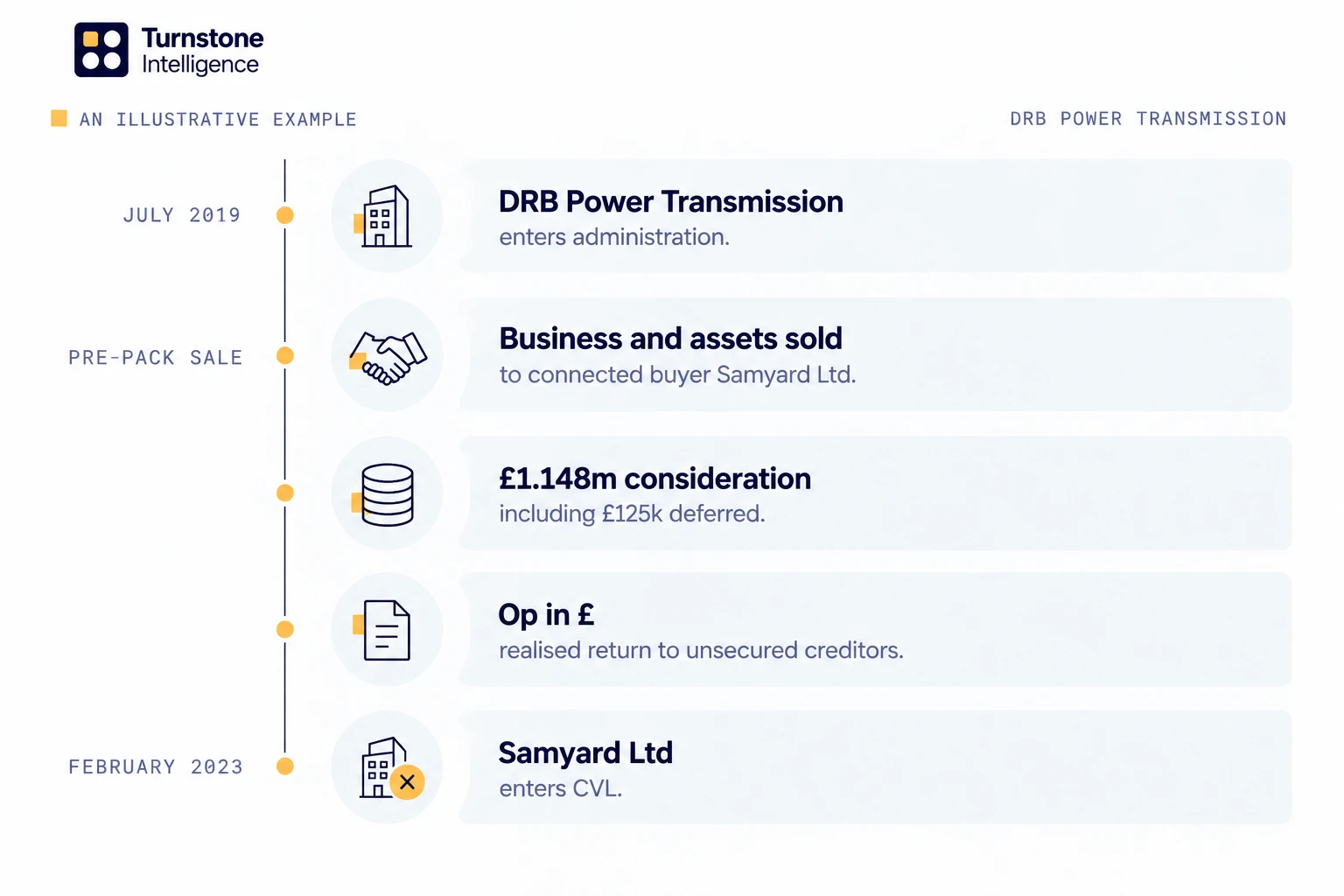
This is one case, so it shouldn’t be treated as representative of every connected pre-pack. What makes it useful is how it brings together the different pieces of information behind a single transaction. The failed company, the buyer, the connection between them, the deal structure, the creditor position, and what happened to the buyer afterwards.
It’s the connection between those facts that makes the history of the transaction more revealing.
A company doesn’t tell you the whole story
This insight is important well beyond pre-packs. Risk decisions are often made around a company, including whether to lend to it, insure an exposure, fund a claim, pursue a recovery, or enter a commercial relationship.
But the information that could change that decision may live elsewhere.
It might be in a director’s history. A connected company. An earlier insolvency. A previous transaction. A creditor outcome. A change in ownership. Or a relationship between businesses that only becomes significant once the wider history is visible.
The findings from this research demonstrate the value of following those connections over time. A single company record is a snapshot. Risk often has a history.
And depending on the decision being made, different parts of that history are key.
The same information can change very different decisions
The research started with insolvency, but what it tells us has much wider relevance.
How much do you really know about the company, people, and relationships behind a decision?
- For an insolvency practitioner, that might mean understanding where directors have been before, which businesses they have been connected to and where there may be recovery opportunities.
- For a litigation funder, the same intelligence could help build a fuller picture of a defendant, the businesses and people around them, and factors that could affect recoverability.
- For a lender, it can reveal history behind the borrower: previous failures, connected companies, changes in ownership and events that deserve closer scrutiny before capital is committed.
- For a credit insurer, it can add context to an exposure that a score or payment history alone may not reveal.
- And for legal, investigation and due diligence teams, connections between companies, directors and past events can point towards questions that need further investigation.
| Decision | What the wider history can tell you |
|---|---|
| Insolvency & restructuring | Where have these directors and connected businesses been before? |
| Litigation funding | What could affect the defendant’s ability to meet an award? |
| Specialist lending | What’s behind the borrower we are being asked to fund? |
| Credit insurance | What is behind the exposure? |
| Legal & investigations | Which relationships or events deserve a closer look? |
| Enhanced due diligence | Who and what is really connected to this company? |
The 2019 pre-pack data gives us a particularly clear example of why that wider view is so important. And in this study, seven years of subsequent history changed the picture considerably.
Which brings us to an important point the research cannot yet answer.
What happened after the rules changed?
Every administration in this study took place in 2019. This is key because the cohort predates the Administration (Restrictions on Disposal etc. to Connected Persons) Regulations 2021, which introduced new requirements around substantial disposals to connected parties within the first eight weeks of an administration.
Our findings therefore provide a useful pre-reform baseline.
We now know that, within this 2019 cohort, connected pre-pack buyers subsequently entered insolvency at around 1.7 times the rate of unconnected buyers. We also know that the connected + deferred group had the lowest average unsecured creditor return among cases where a realised return was available.
What we don’t know yet is this:
Has that pattern changed since 2021?
Answering it will require another cohort, followed over time. But it gives us something valuable to measure against: a detailed view of what happened before the reforms, and a benchmark for understanding if outcomes look different today.
How we did the research
Turnstone Intelligence analysed 1,738 companies entering administration in England and Wales during 2019, identifying 544 pre-pack sales and following buyer outcomes through to 31 July 2026.
The research combined insolvency filings, SIP 16 disclosures and company records to identify pre-packs, connected-party sales, deferred consideration, creditor outcomes, and subsequent buyer insolvencies.
Where the evidence did not support a reliable conclusion, cases were left unknown or unmatched. 25 administrations could not be classified, while 47 buyer-sale observations could not be reliably matched to a subsequent buyer outcome.
Creditor-return analysis includes only cases where a realised return report was available. The findings identify associations rather than causation.
See the connections that could change the decision
This research started by looking at what happens to the buyer after a pre-pack sale. Answering it meant connecting information across companies, directors, insolvencies, transactions, and years of subsequent activity.
That same approach is at the heart of Turnstone Intelligence.
Our company intelligence brings together the data, relationships, and history behind a business, helping risk professionals find the information that could affect a decision.
And with Dani, our AI research analyst, that intelligence can be investigated in depth: from assessing a lending decision and funding a claim to reviewing an exposure or investigating a recovery.
Talk to us or give Dani a company, case or question to investigate.