
Insights / 2 November 2026
Would you put your money
behind this case?
A composite litigation funding case: see what the funder was told, what Dani found about the defendants, and whether you'd still fund it.
You're reviewing a request to fund a £5.6 million claim. The joint liquidators of an insolvent facilities services company want funding to pursue its two former directors and its parent company for wrongful trading and misfeasance. The liquidators think the parent company is where the money is. Are they right?
Let's put you in the funder's seat. You'll see the case as it was presented to you, then what Dani found when she looked at the people and companies behind it. Then you decide: would you put your money behind this case?
This is a composite case. It draws on issues we see again and again in real investigations, with every name, figure and detail changed.
TL;DR: Would you fund this £5.6 million claim?
The liquidators of an insolvent company want funding to pursue its former directors and parent company. The case looks promising. But would you back this claim without knowing more about the people and businesses involved?
We're putting you in the funder's seat. You'll assess the case, make your decision, then see what Dani, Turnstone Intelligence's AI company research analyst, uncovered when she investigated further.
Will you stick with your original decision once you've seen the evidence?
Let's find out. ↓
The case briefing: here's what you know
You're reviewing a funding request from the joint liquidators of Company A, a facilities services company. It went into creditors' voluntary liquidation owing about £7.8 million, and HMRC is the largest unsecured creditor.
The liquidators say the directors should have stopped trading at least 14 months before they did. They also want back £450,000 of dividends paid up to the parent company while Company A was insolvent, and an overdrawn director's loan account of about £300,000.
| Case briefing 001: initial assessment | |
|---|---|
| Briefing | Detail |
| Claim value | £5.6 million |
| Claim type | Wrongful trading and misfeasance |
| Applicant | Joint liquidators |
| Company | Company A, a facilities services company (anonymised) |
| Shortfall to creditors | About £7.8 million, with HMRC the largest unsecured creditor |
| Proposed defendants | Director A (managing director), Director B (operations director) and HoldCo, Company A's ultimate parent |
| Key evidence | The last filed accounts showed net liabilities 18 months before liquidation. The final year's accounts were never filed. |
| Expected recovery | Mainly from HoldCo, which received the dividends |
At first glance, it looks like a reasonable case to fund. The insolvent trading is visible in the public record, the dividends are a clean number, and there's a parent company to pay.
But as litigation finance commentator Nick Rowles-Davies argues on LinkedIn, “recoverability can be the first hurdle in assessing a funding application. A convincing legal case has limited appeal if the defendant cannot satisfy an award.”
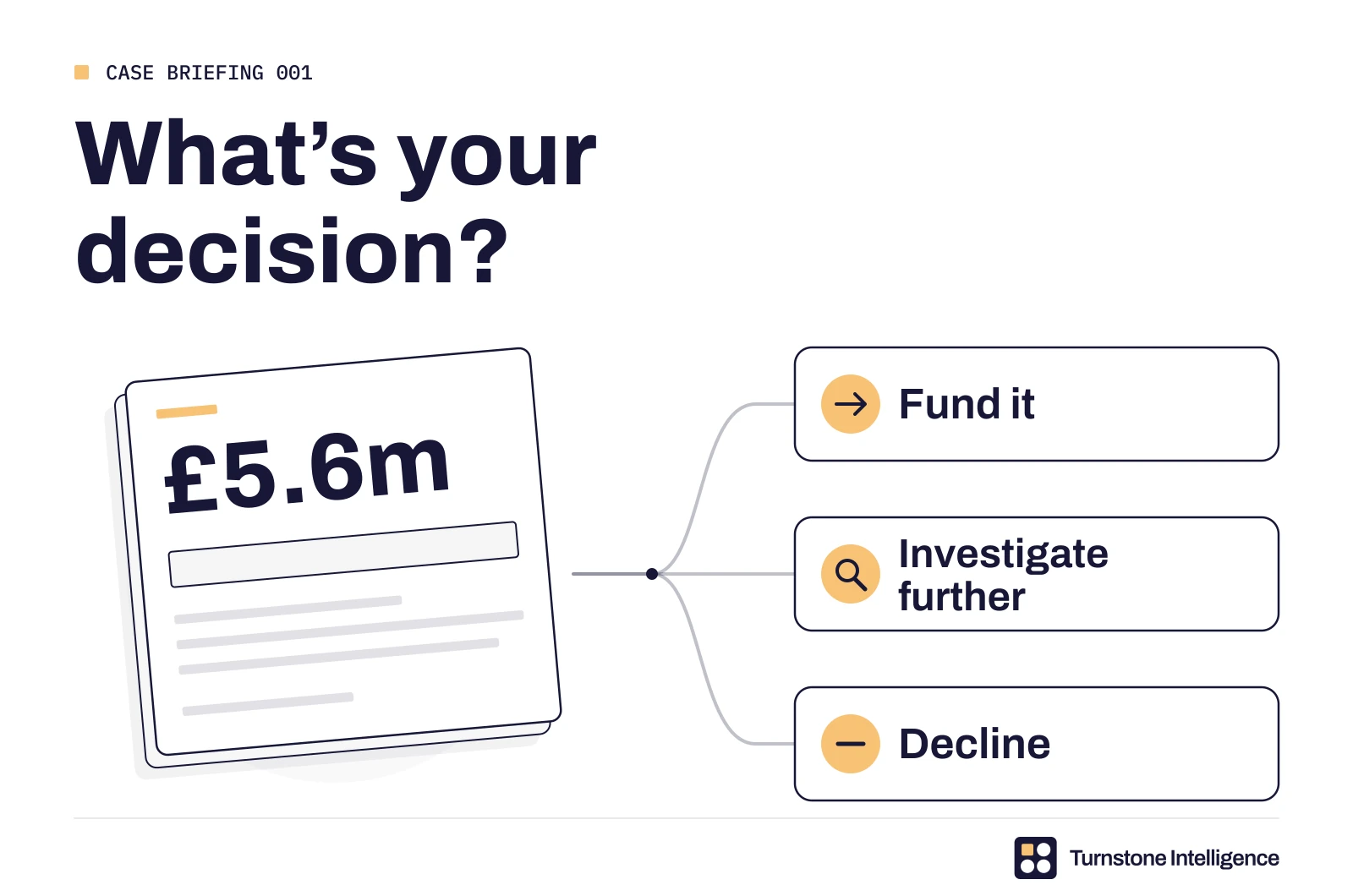
You're taking this case to the investment committee. What's your recommendation?
- Fund it: The opportunity looks promising enough to proceed.
- Investigate further: You need to know more about the defendants and their assets.
- Decline: There's too much uncertainty at this stage.
Make your decision. We'll come back to it once you've seen what Dani found.
Before you commit, what else would you want to know?
Funders aren't short of opportunities. In fact, according to research commissioned by the Legal Services Board, just 3–5% of funding opportunities presented to funders are accepted. With so few applications progressing, funders need enough information early on to decide which cases deserve further investigation.
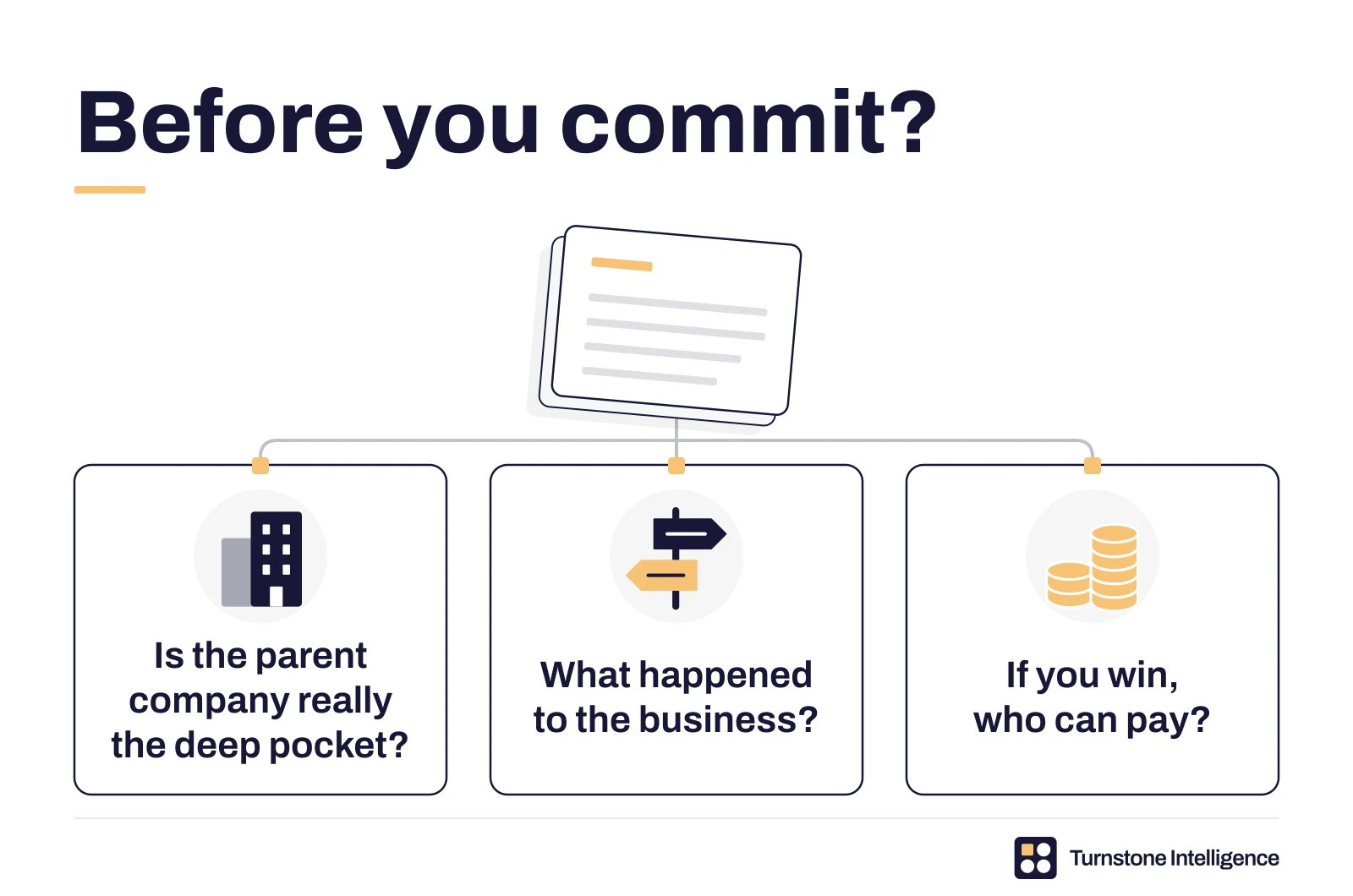
In this case, three questions decide whether the claim is worth backing.
1. Is the parent company really the deep pocket?
The liquidators' recovery plan rests on HoldCo. What does HoldCo actually own?
2. What happened to the business?
Company A had 130 staff and a full contract book two years ago. Where did the customers, staff, and equipment go?
3. If you win, who can pay?
A £5.6 million judgment is only worth the assets behind it. What do the two directors own, and is any of it within reach?
The funding request didn't answer any of these. So Turnstone Intelligence's AI company research analyst, Dani, was asked to investigate the parties and follow their connections.
What Dani uncovered
Using DataNexus, Turnstone Intelligence's UK business information platform, Dani worked through filed accounts, officer and ownership records, the charges register, Gazette notices, and the companies' own websites.
Dani uncovered four findings that could influence the funding decision:
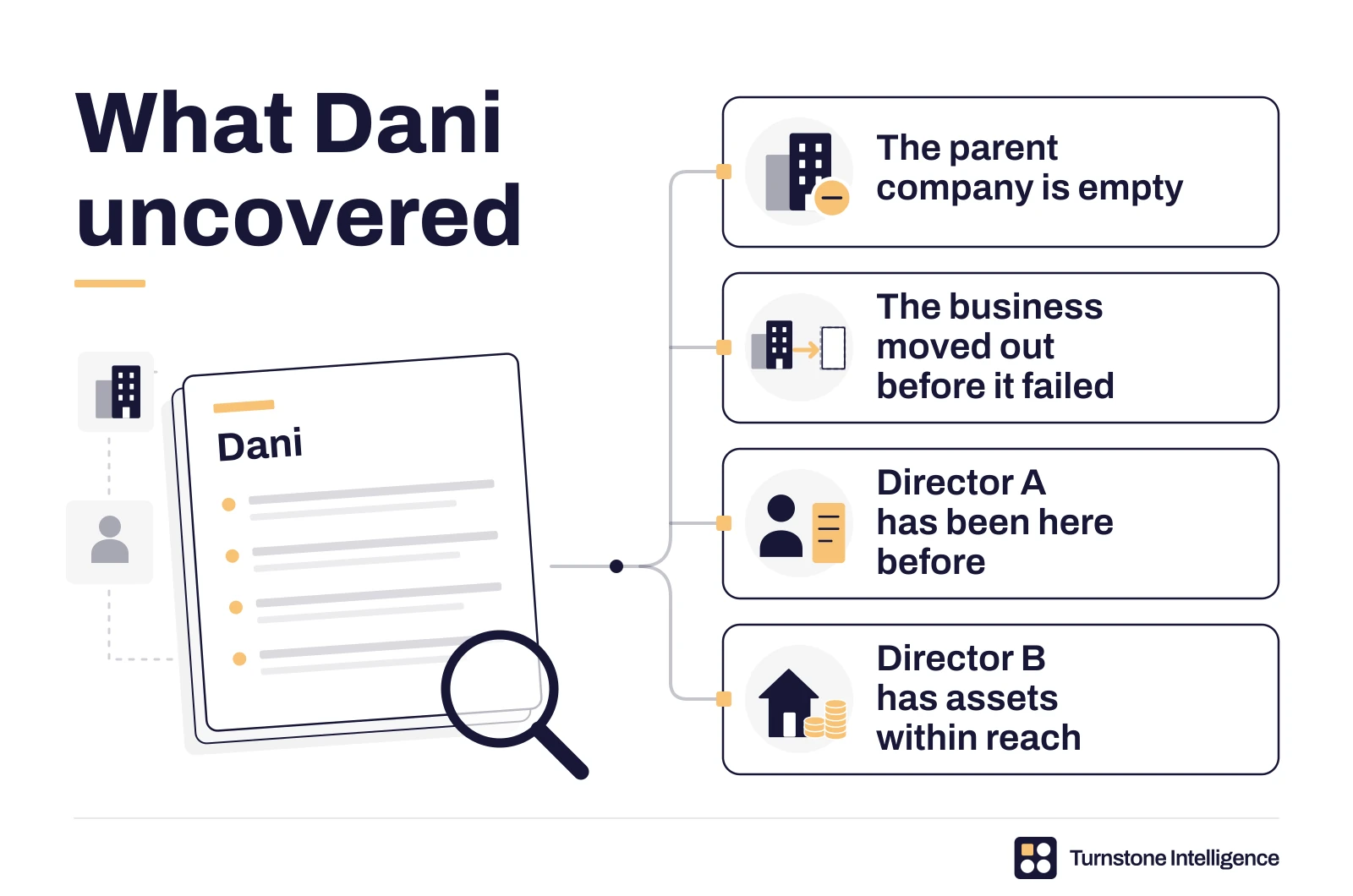
1. The parent company is empty
HoldCo's last three sets of accounts show just two assets: its shares in Company A, and £700,000 it had lent to Company A. Both were carried at full value until the final year, then written down to almost nothing. HoldCo's net assets are now a few hundred pounds. It has no staff and no other subsidiaries.
The charges register shows HoldCo also gave Company A's bank security over everything it owns. Essentially, whatever is left, the bank is first in line.
And HoldCo has stopped filing. Its accounts are overdue, and a first strike-off notice appeared in the Gazette three weeks after the liquidators were appointed. If it is dissolved, it would have to be restored to the register before anyone could sue it.
What this changes: The liquidators' main route to recovery is gone. The dividends remain relevant to the claim, although the focus now turns to the directors who approved them rather than the company that received them.
2. The business moved out before it failed
Nine weeks before the liquidators were appointed, a new company was incorporated with the same trade classification as Company A. Its name is a shortened form of Company A's. Call it NewCo. Its sole director and shareholder appears to be Director B's spouse, with the same surname and correspondence address.
NewCo trades from the same unit Company A did. Dani set aside one change that looks suspicious but isn't: Company A's registered office moving to the liquidators' address on the day they were appointed. (That's routine.)
NewCo's website shows case studies of contracts Company A delivered, and the logos of Company A's two largest customers. Several of NewCo's contract managers list Company A as their previous employer on their professional profiles, with NewCo start dates earlier than NewCo existed.
In the statement of affairs, Company A's equipment was valued at nil. NewCo's first accounts show about £280,000 of fixed assets.
What this changes: It strengthens the misfeasance claim, because the business appears to have moved without being paid for. It also gives you a second defendant that is trading and has assets. And if Director B is involved in running NewCo, the restrictions on reusing a liquidated company's name may apply, which can make a director personally liable for the new company's debts.
3. Director A has been here before
A standard search on Director A returns two previous insolvent liquidations. Dani found six. Companies House held Director A under three separate officer records, with different spellings of a middle name and different service addresses. Matching them on month of birth and address history brought the full record together.
There are similarities across all six company failures. Each time, a new company was formed a few weeks before the old one went under, and the old one was renamed. Two went into liquidation in the same month with the same insolvency practitioner. Across the six, creditors lost about £3.4 million, much of it owed to HMRC.
Director A also sits on the board of a well-funded company with healthy accounts. But Director A holds no shares in it and is not listed as a person with significant control, so none of its assets are within reach.
What this changes: The wrongful trading test takes account of a director's actual experience, and six previous insolvent liquidations is a lot of experience. The claim against Director A gets stronger. The chance of collecting from Director A doesn't: Dani found nothing Director A owns that a judgment could reach.
4. Director B has assets within reach, and they're starting to move
Director B holds 60% of a property company with no connection to Company A's trade. The confirmation statement records the shareholding and the register of people with significant control lists Director B. The property company's accounts show an investment property worth about £2.1 million and net assets of about £1.8 million. Director B is also owed about £250,000 by the company on a loan account repayable on demand.
The property is the unit Company A traded from, and NewCo trades from now.
Six weeks after Company A's liquidation, the bank's charge over that property was marked satisfied and a new charge was registered in favour of a private lender. The property is being refinanced.
What this changes: There is a realistic route to recovery, but the property is being refinanced, and any equity released as cash will be much harder to follow. That is a reason to move quickly, and possibly to ask the court to freeze assets.
A word of caution: None of this proves wrongdoing. A shared address can be innocent, a director's past failures may have nothing to do with this one, and a refinancing can have a sound commercial explanation. Each lead needs testing on its own legal and factual merits. But they are the right leads, and the funding request contained none of them.
Back to the investment committee: would you still fund it?
Quite a lot to take in isn't it? The claim is still worth £5.6 million, but the case for funding it now looks very different.
So, with everything you've now seen, what's your decision:
- Fund it as presented: Back the claim against HoldCo and both directors, as the liquidators framed it.
- Fund a different case: Focus on Director B and NewCo, and move quickly on the property.
- Investigate further: Test the leads before committing.
- Decline: The remaining uncertainty is more than you're prepared to accept.
Here's how we'd read it. The case as presented would be a poor investment, because its recovery plan depends on a company with nothing in it. The re-scoped case is a better one: a stronger claim, a defendant that is still trading, and a director with equity in a property. So, with everything you now know, would you still fund the original claim, or would you take a different approach?
Different funders have different criteria and appetites for risk, so your answer may differ. But would you make the same decision you made at the start? And if not, which finding changed your mind?
| Case briefing 001: updated assessment | ||
|---|---|---|
| What you were told | What Dani found | Effect on the case |
| Recovery mainly from HoldCo | Net assets of a few hundred pounds, the bank ahead of you, and a strike-off notice | Main recovery route gone |
| Director A as a defendant | Six previous insolvent liquidations; no assets a judgment could reach | Stronger claim, weak recovery |
| Director B as a defendant | 60% of a property company with £1.8 million of net assets, plus £250,000 owed on demand | Realistic recovery route |
| Nothing about a new company | NewCo, run by Director B's spouse, trading from the same unit under a version of Company A's name, with its customers and staff | New defendant with assets; stronger misfeasance claim |
| Nothing about timing | Director B's property refinanced since the liquidation | Recovery is at risk; act quickly |
What this case tells us about funding due diligence
The evidence of insolvent trading was there from the start, and the legal case looked sound. The problem was the funding request's assumptions about where the money could be recovered from.
That's no surprise to funders. The Legal Services Board lists the enforceability of a judgment, settlement or award as one of five core considerations, alongside merits, claimant characteristics, costs relative to recovery and claim value. A claim can have strong legal prospects and still be a poor investment.
Three things from this case apply more widely:
1. The answers were all public, but scattered
The clues were scattered across HoldCo's accounts and charges records, NewCo's incorporation record and website, its staff's professional profiles, and the property company's confirmation statement and charges records. Each revealed something useful, and when viewed alongside the others, they gave the funder a very different understanding of the case.
2. Standard searches undercount
Director A's history was spread across three separate officer records, so searching just one would have revealed only two of the six previous company failures.
3. Being a director isn't the same as owning something
There's an important difference between being a director of a financially healthy company and owning shares in it. For a judgment creditor looking to recover money, it's the shareholding that could offer a route to recovery.
Give your analysts more to work with
Experienced funding teams know how to assess legal and commercial risk. What takes time is the research involved, from tracing directorships across multiple records and comparing company accounts to investigating ownership structures and charges across connected businesses.
Dani does that investigative work. Powered by Turnstone Intelligence's DataNexus platform, she researches companies, directors and connected entities, and brings back findings with their sources for your analysts to check. Your team can then spend its time on judgement: which leads matter, and on what terms to proceed.
Did you know?
Our £5.6 million case shows why a strong legal claim doesn't automatically make a good funding opportunity. And it's a challenge the wider disputes market knows well.
According to The London Disputes Report 2026, 67% of surveyed senior UK lawyers agreed that many strong claims are never pursued because of cost or risk concerns.
For funders, understanding who you're pursuing, what assets they hold and how realistic recovery might be can make all the difference to the investment decision.
What could Dani find in a case you've already assessed?
You've seen how additional research could influence the funding decision in our £5.6 million case. Now why not try it with one of your own?
Choose a claim you're currently assessing, one you've previously declined, or one where recoverability remains uncertain.
Give Dani the names of the companies and directors involved. She'll investigate their connections, company histories, ownership structures and available financial records, with sources your analysts can review.
You already know what your team uncovered. See whether Dani can add anything to the assessment.