
Research / 2 October 2026
What standard due diligence misses
(and what it costs you)
An anonymised investigation into a business that looked clean on the company record: what the standard checks showed, what following the connections found, and what the difference can cost.
Every day, significant commercial decisions are made using company records, credit data, KYC checks, and internal research. For most decisions, this information may be enough.
But problems start to appear when the risk lies beyond where standard checks go, such as behind another company, another person, or a shared address.
Here is an anonymised example, based on real investigations, showing how easily those connections can be missed.
What are Turnstone Intelligence and Dani?
Turnstone Intelligence provides deeper company intelligence for important commercial decisions. Our UK company data already powers five of the six major credit reference agencies.
Dani is our company research analyst. Give Dani a company, director, case, counterparty, or question and she investigates it, following connections across our data and external sources, cross-checking the findings and showing you the evidence behind them.
In short: you give Dani the question. She does the digging.
A company that looked clean
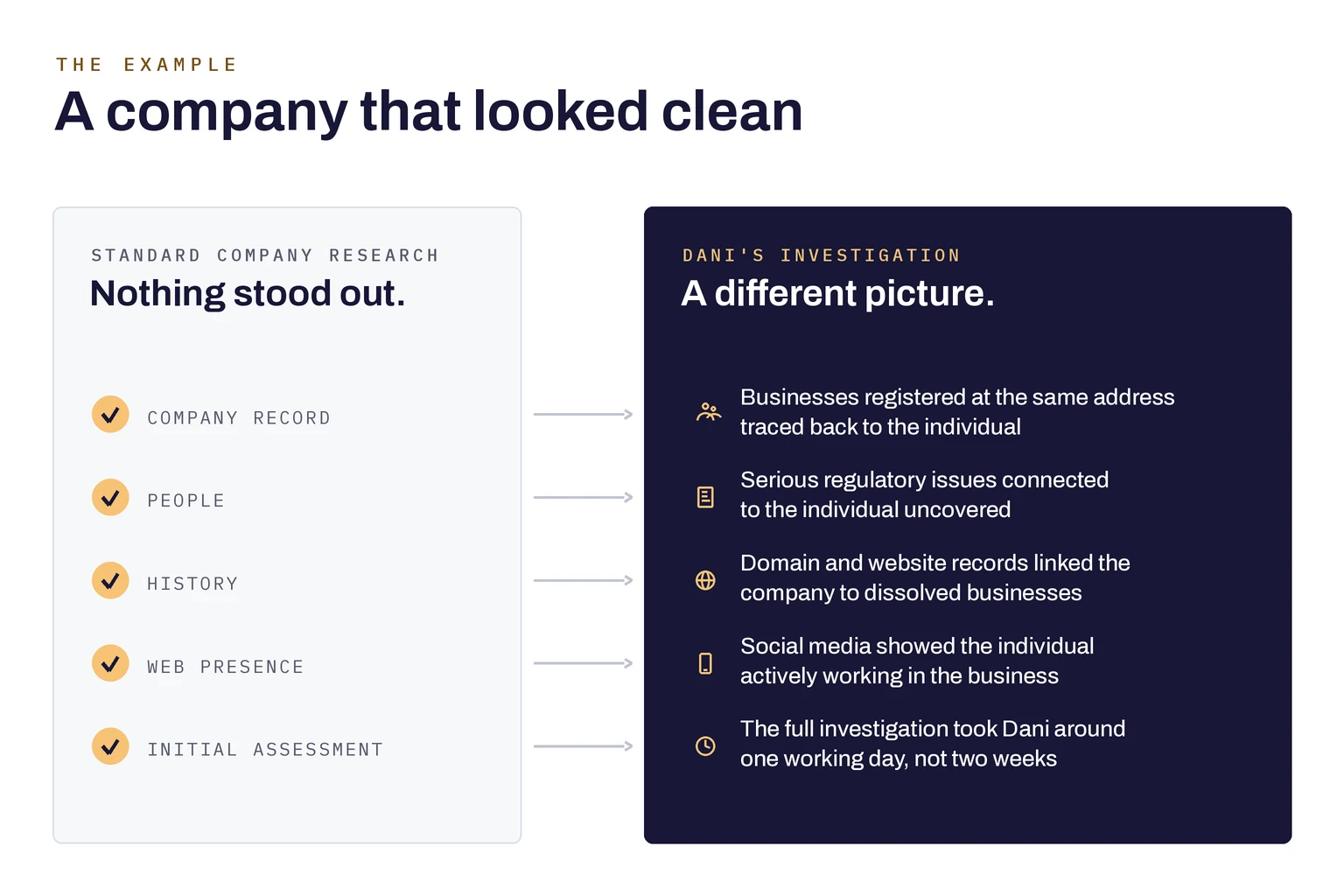
Take a business seeking a significant lending facility. The initial checks gave no cause for concern. The company appeared to be a fresh, unrelated business. There were concerns about a particular individual, but the company record showed no connection to them.
There was a hunch that the official record wasn't telling the full story, so the company was put to Dani. What came back showed just how much can be missed when due diligence stops at the company record.
Here is what the standard checks showed, and what Dani found when she went further.
The Dani investigation
The company record was only the starting point. Dani followed the connections around the business, checking company data alongside web, domain, regulatory, and other sources.
And that is where Dani started finding the connections.
| What was checked | Standard company research | What Dani found |
|---|---|---|
| People behind the business | The individual had no recorded role or connection to the company. | Following links through other businesses registered at the same address led back to the individual. |
| Previous history | The company appeared fresh and unrelated to the individual's previous businesses. | The investigation uncovered serious regulatory issues connected to the individual. |
| Web and domain history | A search of the current company would give little indication of its history. | Domain records and website structures revealed links to dissolved businesses previously associated with the individual. |
| The current operation | The official company record showed no involvement from the individual. | Social media showed the individual describing themselves as actively working for the new business. |
| Time to investigate | Reaching the same depth manually was estimated to take around two weeks, including specialist web-forensics support. | Dani completed the full investigation in around one working day. |
In short, the company record showed no connection. Yet the address, businesses, websites, and domain history told a different story.
What would you do with this information?
The answer depends on the decision in front of you.
- For a lender, a hidden connection to someone with a concerning history could change the risk appetite for the deal, the terms offered, or the security required.
- For a litigation funder, the same type of investigation could uncover evidence relevant to a claim, or give the team more information about the people and businesses involved before capital is committed.
- For an insolvency practitioner, following connections between directors, businesses, and previous failures could point towards conduct or transactions that deserve further investigation.
- For a credit insurer, it could reveal information that changes how an exposure is understood or assessed.
Dani's job is to do the digging early enough for that information to be useful.
The commercial cost of incomplete due diligence
Missing connections like these can have a very real cost. A lender could extend a significant facility without knowing who is really involved in the business. A litigation funder could commit capital without evidence that might affect the case. An insolvency practitioner could close an investigation without following a potential recovery route.
And sometimes the cost is simply time: experienced people spending days piecing together information that could have been found much sooner.
By the time the missing information comes to light, the money may already have been lent, the case funded or the opportunity to investigate lost.
Why standard due diligence doesn't always get you there
You might be wondering how much of this your existing data, research tools, or internal team could uncover already. It's a fair question. So let's deal with three of the most common assumptions about deeper company research.
“We already have company data”
You probably do. Dani uses it too: we supply underlying UK company data to five of the six major credit reference agencies. Dani starts there, then follows the investigation beyond the company itself.
“Our team can do this research themselves”
Some of it, yes. Company records, director histories, and adverse media can all be researched manually. Other parts may need more specialist work. In this investigation, that included tracing domain histories and examining website structures to establish links between businesses.
Recreating the full investigation manually was estimated to take around two weeks, including outsourced technical checks. Dani returned the research in around one working day.
“How do we know where the information came from?”
Every material finding is sourced and cross-checked, with the evidence included in the report. If something could affect a lending decision, a case or an appointment, your team can check the source for themselves.
Put Dani to the test
The easiest way to see what Dani can find is to give her something you already know. Choose a borrower, counterparty, director, defendant, or company your team has researched before. It could be a live matter, or one where you already know how the story ended.
Send Dani the question and we will follow up personally about a sample briefing. A full investigation is scoped with you before work starts. You know what your current research found. See what the research adds.